

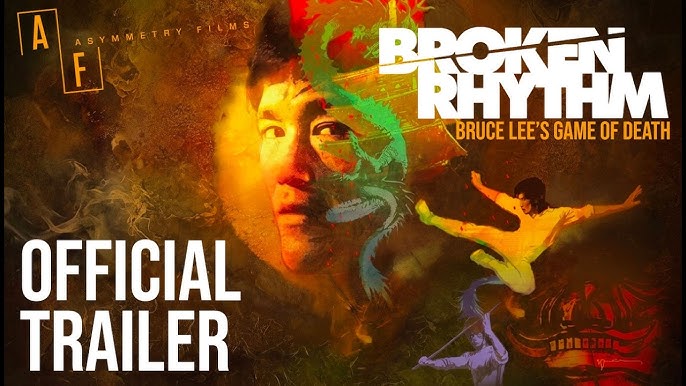

New trailer for what might be the definitive documentary on Bruce Lee and his film, Game of Death presented in a feature length.
Bruce Lee’s unfinished film ‘Game of Death’ has long captivated audiences. The footage he shot before his untimely passing – later reworked and incorporated into a film bearing the same title – carries a mysterious, almost mythic allure. Within these fragments lies a striking cinematic language and rich symbolic intent, revealing Lee’s ambitions not merely as a martial artist, but as a visionary actor, writer and director. What was he striving to express through this project, and what does it reveal about an artist too often reduced to the label of kung fu icon?
Alan Canvan’s ‘Broken Rhythm’ is the first feature-length documentary to examine ‘Game of Death’ in depth, illuminating Lee’s aspirations as a filmmaker at the dawn of the New Hollywood movement and marking his earliest attempt to create what he described as “multi-level films.” The 1978 release – premiering five years after Lee’s death – contained only a fraction of what he filmed in 1972. Producer André Morgan, involved in both versions, guides us through the complex timeline behind the film’s completion, shedding light on the creative, financial, and logistical compromises that reshaped Lee’s original vision. By reassessing the commercial success of the 1978 version, ‘Broken Rhythm’ journeys backward to uncover a markedly different film than the one audiences ultimately saw.
Through exclusive interviews and rare archival material, ‘Broken Rhythm’ highlights an ensemble of voices offering firsthand insight into Lee’s life, work, and creative ambitions. Featured participants include those who worked closely with Lee on ‘Game of Death’, such as Andre Morgan, Dan Inosanto, and Ji Han Jae, alongside biographer Matthew Polly and playwright David Henry Hwang, who offer fresh perspectives on his artistic intent. Actress and producer Colleen Camp adds further dimension, reflecting on Lee’s enduring power as a cinematic icon. Together with additional voices, these accounts uncover revelatory details about the production of ‘Game of Death’, recontextualizing Lee’s legacy while exploring how his work grapples with enduring existential questions of life, death, identity, and the pursuit of artistic immortality.
-City on Fire