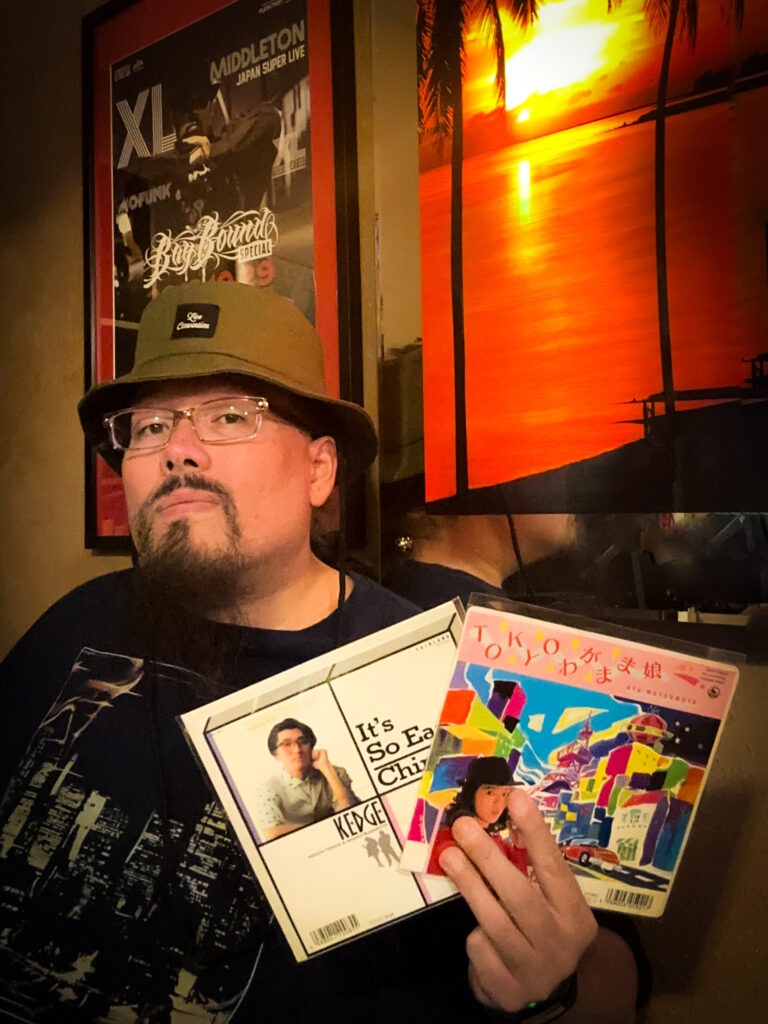
This is a long overdue interview series that I’ve wanted to do with some of my favorite DJ’s who were a part of helping to build the City Pop and Asian music culture scene before it became a trend here in the states. The idea for the series originally started in 2024 but never fully came to light but now that the genre has become more wide spread and known, there’s no better time than the present time to dive right in and have a chat with a few guest DJ’s that are seasoned in the sound. My first exposure to the sound of City Pop in the context of actually hearing in it’s proper setting of Japan happened back around 2013 while in Fukuoka Japan on tour. During one of my off days, a DJ friend named Toyo The Pimp took me to a tiny bar where an older gentlemen probably in his 60’s was playing an amazing set of music that sounded familiar but I couldn’t place my finger on it’s origins. The music was very reminiscent of the music that I had been hearing in anime series that I had been watching since my childhood and teen years of the 1980’s which evoked strong nostalgia within me. After about 30 minutes or so, the DJ saw the continued excitement in my face and began showing me the picture covers for each record. During that time, I don’t recall him labeling it city pop nor had I heard any other DJ’s in Japan curating entire sets for the genre and I had been traveling to Japan since 2007. Not to say he was the first person doing so, but he was the first person that I had heard. Most of the nights that I had played or been to in Japan were all based around funk, soul, jazz-funk and rare groove scenes and even on the occasion that I would play one or two similar style songs in my set, eyes were wide with wondering why and how I knew those songs. I’ve always loved the sound of Japanese female voices especially in these types of songs so I began to buy many of the records that the older DJ had shown me as well as others. To my surprise, those records were rather inexpensive and were solid listens all the way through. But I never bought them to DJ out with, I simply enjoyed listening to them at home which brought a sense of peace and balance from the outside world. It was shortly afterwards, maybe a year later that I started to hear the term city pop more as well as seeing it listed as a genre on flyers. City Pop? hmmm… what’s that? It wasn’t until I went to a night in Tokyo that I connected the dots and put two and two together. It was a similar experience with library music for me as well. For most, library music came from collecting records but for me, hearing library music was visual because I had been watching the British TV series like The Avengers, The Persuaders and others so my connection came from seeing certain scenes and hearing the cues that were played during it. And as time started to pass, city pop became a common theme at parties here in the states, records that were once very inexpensive began to rise in price and become expensive grails and collectible.
So now that city pop has your attention, let me introduce you to some amazing DJ’s who all play sets geared around the genre from East to West Coast. Since the closest point of origin to Japan is California, it’s only right that I begin with one of my favorite DJ’s and producers, XL Middleton. A name that you should be familiar with since we’ve reviewed plenty of his records here at Nostalgia King and ones that you probably have in your crates or have heard in DJ sets.
Skeme: Can you introduce yourself and let the readers know where you’re from, what you do or are known for.
XL Middleton: I’m XL Middleton, producer/artist/record collector/DJ from Pasadena, California. I’m probably best known for producing modern funk & g-funk music but a lot of people may not realize that I’m also heavy into collecting records & my collection is at a level that is not unlike most of the guys who are constantly posting records for ‘content’ on social media. One of my special points of interest as far as collecting, gaining and sharing knowledge is City Pop music.
Skeme: When did you first become interested in Japanese culture and / or the music that become globally known now as City Pop?
XL Middleton: It’s always been an interest for me as a person of Japanese/Okinawan descent. I didn’t grow up around too many other Japanese folks aside from family so my interest in the culture was a way to try and feel some sort of connection to my roots, to close that gap that comes from being ‘Americanized.’ So City Pop was just one expression of that. I think it was 2001, I had graduated high school not too long before. My homie Adrian, who later got known to people as Big Syphe from the radio station Power 106, he came through with this compilation of rare soul tracks, the type of thing you could often find at Fat Beats, almost certainly a bootleg. I got put on to a few things from this comp, crazy shit like Travis Biggs “Tibetan Serenity.” But the number one track that caught my ear was Tatsuro Yamashita’s “Dancer.” It blew my mind that Japanese musicians were making music like this in the 70’s. I had no idea! It sounded like something that Jay-Z *wished* he could’ve found to sample on “Reasonable Doubt.” But back then I wasn’t as immersed in the record collector community. I was mainly just buying records from the 50 cent bin to find samples or inspiration, so I never connected with anyone who could’ve put me on to even more Japanese music like that back then. But that was when the seed was planted. Beyond that, collecting records in general led me to City Pop. Every dedicated collector will find themselves stumbling down any number of rabbit holes. For the most part, City Pop is a Japanese take on styles of music that were created & developed by Black American musicians – R&B, funk, soul, jazz, rock. The interesting thing is that they probably wanted to recreate these musical styles precisely but were rarely able to do exactly that. It was filtered through their own artistic lenses which also carried influence from Japanese traditional & folk music. So it’s something that appeals to your sense of nostalgia with the familiarity, but there’s something a little different about it too; a twist if you will, and that’s a big part of what I think makes City Pop so fascinating to people.
Skeme: What made you want to start a night dedicated to the genre and what gave you heart to do so especially with most of the music not being familiar to American audiences which can be a tough sell to the public?
XL Middleton: In the 2010’s I started connecting with people who shared an interest in City Pop and finally started consistently getting my hands on the records. One of the main people I would talk City Pop with was my man Tremaine. After years of sharing music with each other we finally decided to start a night. He recommended we bring Kaistar into the mix and I was super down with the idea because he was another dude who I had talked City Pop with on occasion, so I knew he had the records too. We launched Tokyo Love Song in February of 2020. The night was a hit; I could see that there was a wider interest in this particular niche. But, you know what happened in March 2020, so we weren’t able to follow up and build on it. Still, I knew there was potential in it. It felt like one of my weird, super niche interests had finally lined up with something that people were collectively getting into on a bigger scale. It felt like the time was right. We kept it going with some streams during Covid times; Tremaine moved to Seattle but Kaistar and I were able to re-launch the night in real life in 2023.
Skeme: What do you find to be special about playing music from Japan on American soil and in a club / dance party setting?
XL Middleton: There’s a certain thing about Japanese culture, and probably all east Asian cultures, that makes it ‘exotic’ to Americans & to westerners in general. This can easily cross into fetishizing territory so we’re here to show you that this music is serious. It’s not just anime pfp’s, future funk samples & imaginary nostalgia while listening to “Plastic Love” on YouTube. Like, I’m really happy those things have helped to create an awareness of the music but there’s more to it. It’s much more dynamic; it has so much more depth and we want to show that with great selections and great mixing. We’ll play “Plastic Love” and “Stay With Me” and “Dress Down” and all those canon tracks but we’ll never let you forget the fact that there’s so, so much more out there. We want to help you get familiar with it while you’re dancing and having a great night.
Skeme: In addition to dance party nights what other types of events do you do that you incorporate playing City Pop?
XL Middleton: I’ve done a few DJ sets in more laid back settings where it’s more focused on selecting. That’s fun too because I can get more into the slower joints and the weirder stuff. Kaistar and I are also launched Tokyo Love Song as a record label. We’ve already done some mix cassettes & CD’s and we’re planning to bring you some original releases in the future as well.
Skeme: Let our readers know about your night dedicated to City Pop and where it all goes down.
XL Middleton: Our night is called Tokyo Love Song. It’s Kaistar and I sharing our favorite Japanese records from our collections. We tend to focus on the 80’s, more so on Japanese boogie & synth pop. We play a lot of the 70’s stuff too but we feel like that lane has already been well studied & covered by other heads who love it. Our passion is to put you on to what you didn’t know, and hopefully spark a level of interest that’ll keep you wanting to discover even after you’ve gone home for the night. All wax except for when we occasionally get into some of the 90’s Heisei era stuff that was never pressed on vinyl. We also make it a point to play as much modern day City Pop as we can. I was in Japan last October and I was happy to find a few 70’s & 80’s releases that had been on my want list, but my number one mission was to find the new artists and new releases that keep the genre ever-evolving. We do it every other month at Hello Stranger in Little Tokyo, Los Angeles. It’s my favorite space in LA and my understanding is that it was a nightclub in the 90’s that catered to a mainly Japanese clientele, so we feel like it’s the perfect spot for us to do this night for a number of reasons. If you’re in LA, whether living here or just visiting, we hope to see you there!
Since we previously conducted this interview, be sure to stay up to date by following XL Middleton on Instagram to find out where he’s playing or touring. And be sure to check back next Monday with our next featured interview with DJ Kaistar.